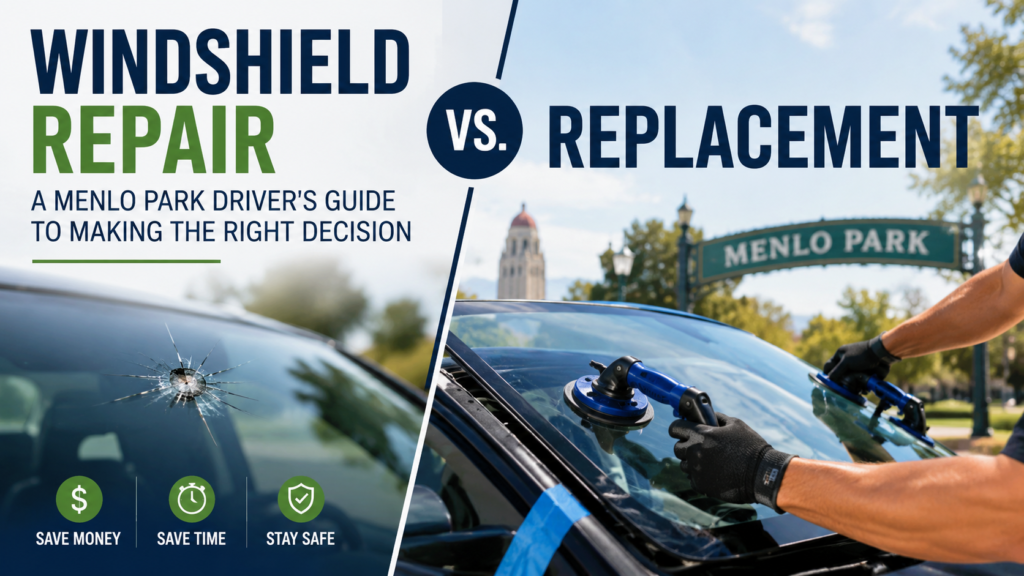
Menlo Park sits at the heart of the San Francisco Peninsula, bordered by Highway 101 to the east and Interstate 280 to the west, with Sand Hill Road one of the most famous addresses in Silicon Valley running through its center. It’s a city of intense commuter activity, significant daily vehicle traffic, and roads shared by everyone from Stanford students to venture capital professionals to families navigating the El Camino Real corridor. When a chip or crack appears on a windshield in Menlo Park whether from debris on the 101, a falling branch on a tree-lined residential street, or road gravel from a construction zone the question that follows almost immediately is the same: repair, or replace? This guide explains the factors that determine the answer.
The Fundamental Difference Between Repair and Replacement
Windshield Repair vs Replacement Menlo Park is the injection of a clear resin compound into the damaged area of the glass, which bonds with the surrounding glass, cures under ultraviolet light, and restores structural integrity. It is a relatively quick procedure typically 30 minutes that addresses damage limited to the outer layer of the windshield’s laminated glass structure. Repair preserves the original glass, costs significantly less than replacement, and can often be covered at no cost under comprehensive auto insurance.
Windshield replacement is the complete removal and substitution of the damaged windshield with a new piece of glass. It is required when damage is too extensive, too deep, or too sensitively located for repair to produce a safe and optically adequate result. Replacement takes longer typically one to two hours for installation, plus the safe drive-away cure time of one to four hours and is more expensive, though again typically covered at least in part by comprehensive insurance.
The Four Deciding Factors
Auto glass professionals evaluate four key factors when determining whether damage is repairable or requires replacement:
- SIZE: The clearest criterion. Chips smaller than approximately one inch in diameter (about the size of a quarter) are generally repairable. Cracks up to three inches long may be repairable. Beyond these dimensions, replacement is typically required. Why? Larger damage means more void space for the repair resin to fill and larger voids are less successfully stabilized by injection, leaving optical distortion and structural weakness.
- LOCATION: Damage in the driver’s primary line of sight the area directly in front of the driver’s eyes during normal driving requires careful consideration. Even a successful repair leaves a slight optical distortion at the repair point. This distortion in the driver’s direct forward view can cause visual interference during night driving, in bright sunlight, or in rain. For this reason, many professionals recommend replacement when damage falls within approximately six inches of the driver’s direct sight line. Damage at the edge of the windshield within two inches of any edge almost always requires replacement because edge damage compromises the urethane seal bonding the glass to the vehicle frame, which is critical for structural integrity.
- DEPTH: Windshield glass is laminated two layers of glass bonded together with a plastic interlayer. Repairable damage affects only the outer glass layer. If the impact has penetrated through the plastic interlayer to the inner glass layer, repair cannot restore structural integrity and replacement is required. Technicians assess depth during the initial inspection of the damage.
- AGE OF DAMAGE: Fresh damage is far more successfully repaired than old damage. Chips and cracks that have been left open to the environment for days or weeks fill with road dirt, moisture, and debris. This contamination prevents the repair resin from bonding cleanly with the glass, producing a poor result even with expert technique. In Menlo Park’s fog and coastal moisture environment, chips that collect moisture repeatedly before being repaired are particularly compromised. The practical message: address windshield damage promptly, before weather or the passage of time makes repair less viable.
The Danger of Letting Damage Spread
One of the most important things Menlo Park drivers should understand about windshield damage is that it rarely stays the same. Chips spread into cracks and cracks grow longer over time, driven by three primary forces:
- Temperature cycling: The Bay Area’s daily temperature swings between morning fog and afternoon warmth cause the glass to expand and contract. This thermal movement stresses the damaged area and can cause cracks to extend with each cycle.
- Vibration: Normal driving vibration over the rumble strips on the 101, on the rough patches of El Camino Real transmits stress directly to damaged areas of the windshield.
- Air pressure changes: The pressure differential between the inside and outside of the vehicle when doors are opened and closed, and the wind pressure at highway speeds, creates forces that act on cracks and can cause them to propagate.
A chip that is repairable today small, clean, away from the edge may be a crack requiring full replacement in two weeks. Repair done promptly is almost always preferable to replacement done later because the chip was ignored.
California Law and Windshield Condition
California Vehicle Code Section 26710 prohibits operating a vehicle with a defective windshield that “impairs the driver’s vision.” While the code does not specify exact crack dimensions, a windshield with extensive cracking or damage in the driver’s direct field of vision is subject to a fix-it ticket. Beyond legal compliance, the safety case for maintaining an undamaged windshield is compelling: the windshield contributes significantly to a vehicle’s structural integrity during a rollover, helps retain the roof in a crash, and is a critical component of the airbag deployment system the passenger airbag deploys against the windshield, using it as a backstop to direct the bag toward the passenger. A windshield with compromised adhesion or structural integrity may not fulfill these safety functions properly.
ADAS Sensors and Camera Recalibration
Many modern vehicles including the Tesla, Volvo, Mercedes, and BMW models that are particularly common in Menlo Park feature Advanced Driver Assistance Systems (ADAS) including forward collision warning, lane departure warning, and automatic emergency braking. These systems rely on cameras and sensors mounted to or behind the windshield. When a windshield with these systems is replaced, recalibration of the cameras and sensors is required to ensure the systems operate correctly. This recalibration can be performed statically (in a calibration bay using target boards) or dynamically (by driving the vehicle through a calibration procedure). Failure to recalibrate after replacement can cause these safety systems to malfunction, triggering false alerts or failing to detect genuine hazards. Menlo Park drivers with newer vehicles should confirm that their auto glass provider includes ADAS recalibration in their replacement service.
OEM vs. Aftermarket Replacement Glass
When replacement is necessary, Menlo Park drivers will often encounter a choice between OEM (Original Equipment Manufacturer) glass and aftermarket glass. OEM glass is manufactured to the same specifications as the original glass installed by the vehicle manufacturer, often by the same supplier. Aftermarket glass is manufactured by third-party producers to fit the vehicle but may not meet identical specifications. For most standard vehicles, quality aftermarket glass is an acceptable choice. For vehicles with integrated ADAS systems, heated windshields, heads-up displays, or other advanced features built into the glass, OEM glass is strongly recommended to ensure these features function correctly with the replacement glass.
The Repair Process Step by Step
For drivers who have never had a windshield repaired, understanding the process demystifies it. A mobile technician arrives at the customer’s location a Menlo Park office, a home in the Willows neighborhood, a Stanford campus parking structure and performs the repair on-site. The technician inspects the damage, confirms it is repairable, cleans the damaged area of any loose glass, moisture, or debris, and places a bridge device over the chip to create a sealed chamber. Resin is injected under pressure into the void, filling all the cracks radiating from the impact. UV light cures the resin, and the surface is polished smooth. The vehicle is ready to drive immediately after the repair.
Conclusion
For Menlo Park drivers, the decision between windshield repair and replacement is guided by the size, location, depth, and age of the damage. When doubt exists, consulting a professional auto glass technician for an assessment most will provide this inspection without charge is the fastest path to a confident decision. Prompt attention to windshield damage is always the best policy: it preserves the option of repair rather than replacement, prevents the damage from spreading, and keeps Bay Area drivers safely on the road.